Why AI Fails Without Redesigning the Work
From Productivity to Performance: What Most AI Transformations Get Wrong (Part 2)
Many organisations are still unclear on what they are trying to achieve with AI. Despite growing activity and investment, leadership intent is often mixed or unclear, inconsistent, and in many cases, unresolved. In the absence of that clarity, organisations default to what they know.
They apply AI to existing processes, existing decision structures, and existing organisational boundaries, rather than stepping back to redesign them. As a result, activity increases, but it is not directed. And without direction, outcomes do not materially improve
The core problem
AI is often introduced into existing workflows, decision structures, and organisational boundaries without fundamentally changing them. Processes are automated, but not simplified. Insights are generated, but not acted on. Decisions are supported, but not reallocated.
In effect, organisations become faster at doing the same work, rather than better at delivering outcomes that matter. There is a lot of noise and activity but the results which were expected fall short. This is where productivity gains stall.
A widely recognised problem
Rob Llewellyn of CXO Transform describes two distinct approaches to enterprise AI. The first is optimisation, where AI enhances the current business model. The second is transformation, where AI enables the creation of the next business model. As he summarises it, one improves today, while the other invents tomorrow.
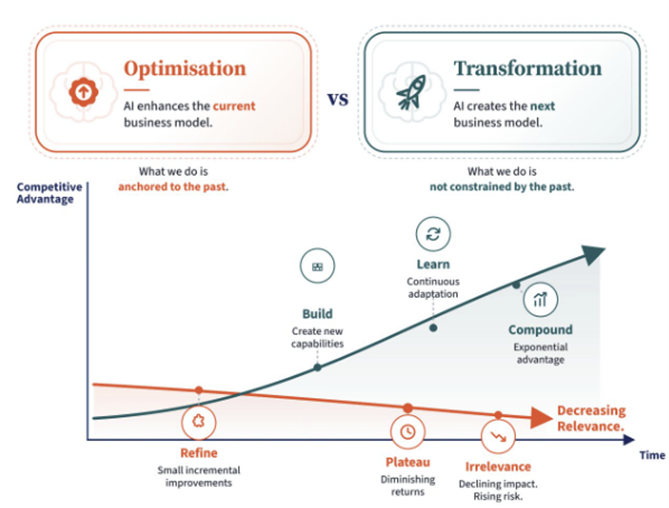
Source: Rob Llewellyn, CXO Transform Two Enterprise AI Mindsets
What this framing makes clear is the trajectory many organisations are currently on. When AI is applied to existing ways of working, gains are incremental and eventually plateau, and over time, relevance declines.
By contrast, when organisations use AI to rethink how work is done and how value is created, advantage grows. The distinction itself is not new. The challenge lies in execution.
Many organisations believe they are pursuing transformation, while in practice they are still optimising. AI is layered onto existing workflows, decision structures, and organisational boundaries, rather than being used to fundamentally redesign them.
Why this happens
There are consistent patterns behind this. Most organisations begin with what they do today and ask how AI can make it faster or cheaper. Rarely do they step back and ask whether that work should exist at all, or whether it should be done differently. The starting point remains the current process, rather than the desired outcome. This stems directly from unresolved leadership intent outlined in Part 1of this series in what most AI transformations get wrong.
What Needs to Change
Organisations that successfully convert productivity into performance take a different approach. They don’t begin with the technology. They begin with the outcome they are trying to achieve, and then deliberately redesign how work gets done, using AI as an enabling tool, not a strategy.
This is not about incremental improvement. It is structural redesign. It means stepping back from existing processes and asking more fundamental questions. Work that no longer adds value is removed, not automated. Decisions are redistributed to where they can be made most effectively, rather than held in legacy hierarchies. Teams are aligned around end-to-end outcomes, not functional activity.
This also changes who shapes the work. Business, technology, data, risk, and change capability must come together early to define the problem and design what replaces it, rather than responding after solutions have already been set.
Without that shift, organisations do not transform. They optimise what already exists.
Practical Steps Leaders Can Take
For leaders, this shift is not theoretical. It is operational. It begins with taking a critical business process and examining it end to end. Rather than asking how AI can be applied to each step, leaders need to question why those steps exist in the first place, where work can be eliminated entirely, and where duplication sits across the organisation.
There is also a need to move beyond functional optimisation and focus on outcomes across the full value chain. This requires aligning measures of success, reducing friction between teams, and establishing shared accountability for results.
Early integration of cross functional capability is equally critical. Bringing together business, technology, data, risk, financial, capability and change expertise from the outset ensures that redesign efforts are grounded, practical, and capable of being implemented at scale.
Finally, every initiative must be directly connected to commercial outcomes. Whether through revenue growth, cost reduction, risk management, or customer impact, the link between effort and value must be explicit. Without that connection, gains will not be sustained.
The Implication
AI does not create performance on its own. It exposes the limitations of how work is currently done. Organisations that continue to operate within existing structures will see localised gains, but enterprise performance will remain unchanged.
Those that deliberately redesign work, how it flows, how decisions are made, and how accountability is structured, begin to convert productivity into competitive advantage.
Coming next
Even when organisations redesign work effectively, many still fail to sustain performance gains. This is not a design problem. It is a system problem.
Value dissipates when success measures, behaviours, governance, and leadership routines continue to reflect the previous way of operating. Transformation only becomes real when it is embedded in how the organisation runs day to day.
This is where productivity becomes sustained performance, and where competitive advantage is either built or lost. I’ll explore that in Part 3.