Lots of Activity, Very Little Value
From Productivity to Performance: What Most AI Transformations Get Wrong (Part 3)
There is no shortage of activity when it comes to AI. Across organisations, use cases are being identified, pilots launched, and teams are experimenting with different tools. Leadership is increasingly engaged, and there is a broad sense that transformation is underway.
Despite this, very little of it is translating into sustained performance or meaningful commercial impact.
The core problem
While the organisation appears to be progressing, underlying performance does not materially shift. For example, research from MIT’s work on the “GenAI divide” suggests a widening gap between organisations generating AI activity and those translating it into sustained business value. In most cases, the constraint is organisational integration rather than technical capability.
Changes to work are frequently introduced within existing systems of decision making, funding, measurement, and organisational behaviour. These systems were designed for a different operating model and continue to shape how work is carried out.
As a result, value may be created initially, but it does not persist. Gains are visible in isolated areas yet fail to compound across the organisation. Over time, the initial impact stabilises or diminishes rather than strengthening.
A widely observed pattern
A consistent pattern is emerging across organisations at different stages of AI adoption. Early activity generates momentum and optimism. Pilots demonstrate potential, and specific teams begin to adapt their workflows. At this stage, progress appears strong and the trajectory seems positive.
However, as initiatives move beyond the initial phase, a different dynamic becomes apparent. Gains begin to plateau, outcomes vary across teams, and momentum slows. In some cases, organisations revert to previous ways of operating when faced with complexity or pressure.
What masquerades initially as transformation often results in incremental improvement that lacks endurance.
Why this happens
In many cases, AI is not treated as a strategic shift in how value is created. Instead, it is applied to individual processes, functions, or initiatives in isolation. As a result, organisations deploy AI within their existing strategy and operating model rather than reshaping them.
Leadership intent often remains unresolved at a strategic level which creates a disconnect between the potential of AI and how it is actually deployed.
The result is a gradual dilution of impact. Gains do not disappear immediately, instead they settle into a level that reflects the constraints of an organisation that has not fully reoriented itself around how AI creates value.
How the Klease Method addresses this
The Klease Method is structured to address this progression in a deliberate and practical way, recognising that transformation only delivers value when clarity of intent, redesign of work, and the operating environment itself are aligned. It guides organisations through these phases not as isolated steps, but as a connected system that ensures each element reinforces the others. The diagram below illustrates how organisations move through these three phases, building from understanding and design into sustained performance.
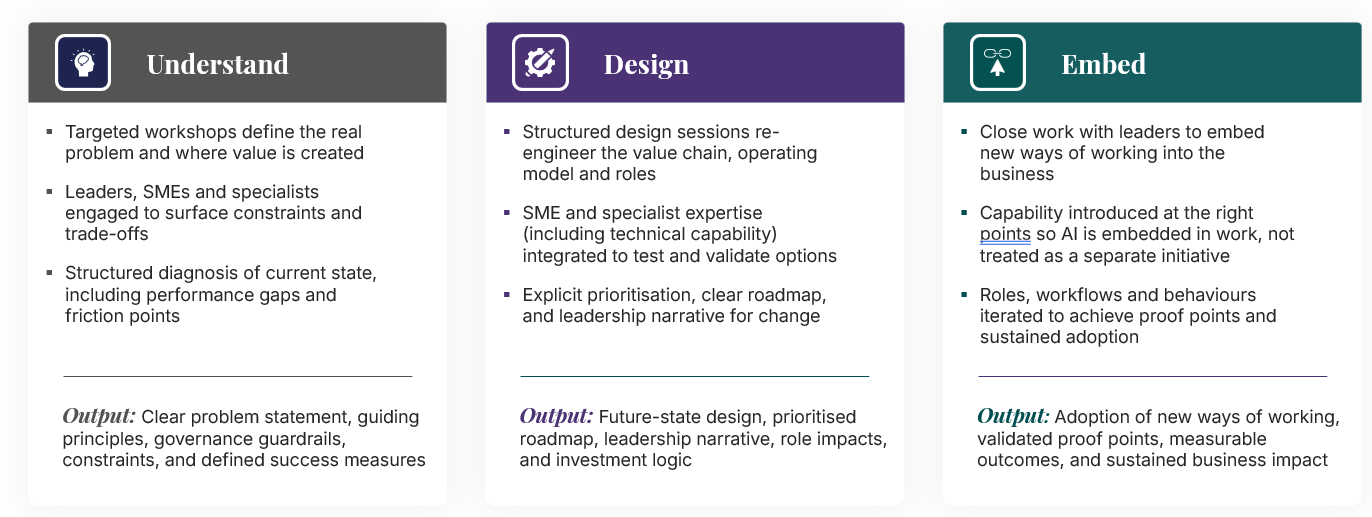
Ultimately, the method ensures that transformation is not experienced as a series of initiatives, but as a shift in how the organisation consistently creates and captures value over time.
Practical Steps Leaders Can Take
Organisations pursuing AI primarily through piloting tools will not translate effort into sustained value. The shift from activity to performance requires discipline across three connected areas.
Re-anchor on the problem and define value clearly
Many organisations move too quickly to solutions without fully resolving what they are trying to achieve. Leaders need to establish a clear and consistent view of the problem they are solving, what success will look like and the guiding principles that will aid decisions across transformation. This becomes the reference point for prioritisation, investment, and trade-offs. Without this clarity, activity expands but impact remains diluted.
Redesign work end to end, not in fragments
Applying AI within existing workflows limits impact. Leaders need to step back and examine how value is created across the full process, removing unnecessary work, examining operating models, and aligning teams and roles around outcomes rather than functions. This requires bringing together business, technology, data, and risk perspectives early so that redesign is coherent and consequences are understood.
Align the system so value is sustained, not just created
Even well-designed changes will not hold if the surrounding system remains unchanged. Leaders need to ensure that new ways of working are consistently adopted and reinforced, not just introduced.
This requires clear expectations for how work is done differently, supported by capability uplift and structured change management. Governance and monitoring must reinforce the shift, with success measures that track whether value is being sustained over time, not just achieved initially. Without this discipline, gains will weaken or disappear.
The Implication
AI does not deliver sustained performance on its own. It exposes whether an organisation is capable of converting activity into competitive advantage.
Where alignment is absent, activity increases but impact remains constrained. Where it is present, gains begin to compound and performance shifts in a way that endures.
This is now a defining leadership challenge that will determine which organisations win, and which fall short.