AI Transformation Is Not a Technology Problem
Why productivity gains fail to become competitive advantage
The World Economic Forum’s latest blueprint on AI transformation landed on my desk this week, and it confirms what many boards are already seeing firsthand.
AI adoption is accelerating. The Forum estimates that AI and information processing will affect 86 per cent of businesses by 2030, with more than a billion jobs likely to be transformed over the next decade. Yet despite this momentum, most organisations are struggling to convert AI investment into sustained competitive advantage.
This gap is not about ambition, intent or access to technology. It reflects a more fundamental misreading of what AI actually demands from the organisation.
Adoption is widespread. Competitive advantage is not.
Across sectors, AI tools are now commonplace. Organisations can point to pilots, platforms, copilots and automation initiatives. Many can demonstrate productivity improvements. Some can point to cost savings or reduced effort in specific functions.
Far fewer can demonstrate that AI has changed how the organisation competes.
McKinsey’s research has also consistently highlighted this divide. While the majority of organisations have adopted AI in some form, only a small minority report enterprise‑level impact. The constraint is rarely technical maturity. It is how AI is framed and integrated into the business.
AI is most often positioned as a productivity lever or a cost‑reduction mechanism. In the current economic climate, that is an understandable instinct. But it comes with a hard limit: you cannot cost‑cut your way to competitive advantage.
Efficiency can protect margins, but it will not re-shape strategic position alone.
The real constraint: under‑investing in how value is created
Productivity gains are failing to translate into competitive advantage because AI is treated as a technology issue.
When this happens, organisations invest heavily in tools, platforms and technical capability, but under‑invest in value chain re‑engineering and change management. Operating models remain largely intact. Work is digitised rather than fundamentally rethought. Job design is adjusted at the margins, if at all.
The capability mix becomes unbalanced. Technical capacity accelerates, while the way work is actually performed remains anchored in pre‑AI assumptions.
This is why many AI initiatives deliver local efficiency but fall short of promised impact. Tasks are completed faster, but the organisation does not operate differently. Dependencies remain hidden. People are expected to adapt to new tools without clarity on how their roles and ways of working are changing.
The organisation becomes more efficient, but not more competitive.
What differentiates organisations that convert AI into competitive advantage
The organisations that move beyond AI experimentation are not doing more. They are being clearer and more disciplined about a small number of fundamentals.
Clear enterprise intent
AI initiatives fail early when organisations are not aligned on the real problem they are trying to solve.
Where intent is clear, leaders are explicit about where value is being lost across the value chain, what constraints matter most, and what success actually looks like. AI is recognised as an enabler of enterprise transformation, not a strategy in its own right.
Without this clarity, AI defaults to isolated use cases and productivity plays that may improve activity, but do not shift performance.
Clear and consistent leadership direction
AI initiatives fail early when organisations are not aligned on the real problem they are trying to solve.
Where intent is clear, leaders are explicit about where value is being lost across the value chain, which constraints matter most, and how success will be measured. AI is recognised as an enabler of enterprise transformation, not a strategy in its own right.
Without this clarity, AI defaults to isolated use cases and productivity plays that may improve activity, but do not shift performance.
Redesigned work and job architecture
This is where most organisations under‑invest.
When AI is treated as a technology initiative, operating models, workflows and job design are left largely untouched. Change management is approached as a rollout activity rather than a core capability.
Where AI creates competitive advantage, the focus shifts from deploying tools to deliberately reshaping how value is created. Leaders are explicit about where capacity is being freed up and intentional about how that capacity is redeployed across the value chain. Work, roles and ways of working are adjusted as part of delivery, not deferred as downstream change.
Competitive advantage enabled by the right capabilities
Organisations that pull ahead do not simply build technical capability. They assemble the right combination of perspectives and skills at the right time across the enterprise. These typically span leadership, workforce and job design, change execution, data and technical capability, operational expertise, financial discipline, and risk and governance.
This ensures AI is embedded into how work is actually done, rather than layered on as a standalone technology initiative.
Why I developed the Klease Method
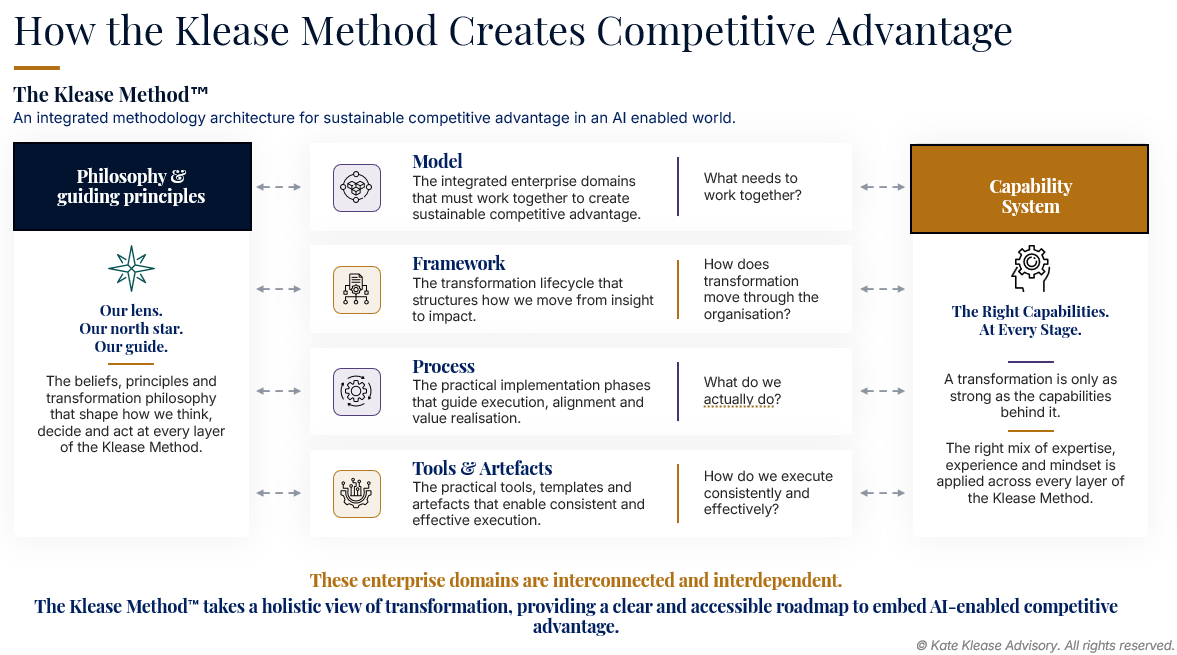
The Klease Method emerged from more than 25 years of transformation experience, seeing where organisations succeed and fall short; re‑examined through the lens of AI adoption.
Organisations are investing in AI and workforce initiatives, but rarely redesigning the value chain as a coherent system that delivers competitive advantage.
I wanted to create a practical way to connect leadership intent, governance, strategy, work design, operating model and capability around how value is actually created and delivered.
The method assumes that sustainable competitive advantage does not come from deploying AI faster, but from reinvesting the capacity AI creates more deliberately than others.
Below is an overview of the Klease Method.
Signal versus noise for boards and executives
For boards and executive teams, the signal is not the number of AI initiatives underway or the sophistication of the tools in use.
The signal is whether the organisation can clearly articulate:
Where operating models and workflows have been intentionally reshaped
How roles and job architecture have evolved in response to AI
How AI‑enabled productivity is being reinvested into the value chain
The noise is familiar: more pilots, more tools, more training, and more claims of progress that do not materially change how the organisation operates.
The World Economic Forum is right to argue that AI value depends on more than adoption. The deeper insight is this: competitive advantage does not come from productivity alone. It comes from how the capacity created by AI is reinvested into work, capability and execution.
Further reading:
World Economic Forum
Invest in the workforce for the AI age: A blueprint for scale, skills and value creation
Read the World Economic Forum article
McKinsey & Company
The State of AI in 2025: Agents, innovation, and transformation
View McKinsey’s global AI survey findings